Pantai Morib Malaysia
  • Home
  • Human Interaction
    • Beach Profiles
    • Litter Graphs
    • Sea Defences
  • Australian Coastlines
    • Soft Engineering
    • Hard Engineering
    • Clean Up Australia Day
  • Recommendations
  • Bibliography

Sea Defences 

Pantai Morib has 3 major sea defences: mangroves, a sea wall and a revetment. We only looked at the sea wall and revetment in close detail. Below are the 3 sea defences with annotations, along with a detailed analysis of the functions and uses such as: posotive/negative aspects of each, the effectiveness, appearance, problems and sustainability.

Concrete Revetment 

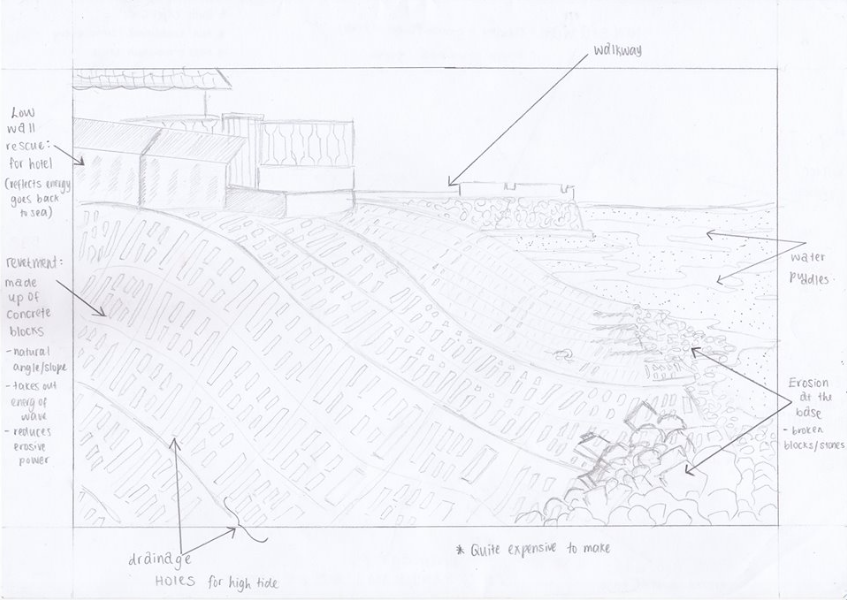
  • As you can see in figure 1, the first sea defence we observed was the reinforced revetment directly in front of a hotel, on the beach (it is also adjacent to the promenade).  
  • Square blocks are made out of concrete and tesselate to create a reinforced revetment. Concrete is quite strong but isn't the best material to beat erosion. 
  • It takes form as a gentle slope to lessen the power and forces of the waves, and allows the water to flow back to sea. This is due to the fact the wall goes with the motion of the wave. 
  • The concrete blocks have holes in them, which weaken the waves and drain away some of the water, so that the wave runs up and then down the concrete. 
  • There is also a short, vertical concrete wall with a angled edge at the top of the revetment to reflect the wave's destructive power back to the sea if there is a very high tide or in a stormy weather. 
Picture
Figure 1: Concrete Revetment directly in front of hotel. 
  • This concrete revetment is quite expensive to build due to the size and effort needed to produce it. I also noticed there were a few cracks here and there and some pieces not in the right place. The revetment should be constantly repaired so it can't work at 100%. 
  • I would rate this an 7/10 for efficiency as the slope is well designed and does the job. But as you could see in the low tide, the base was quite eroded and will continue to be 'eaten away' due to water in low tide constantly hitting against the base. This means this defense will need to be constantly needs to be constant management and repairs. In general, it is a good defense that doesn't need to be replaced often due to the efficient design.  
  • I would rate this a 6/10 for appearance as it looks unappealing and might discourage tourist from visiting due to its unattractiveness. It is very large and sticks out like a sore thumb due to its size and colour, but it is located of at the side, where most people don't go to and isnt accessable. 

Sea Wall 

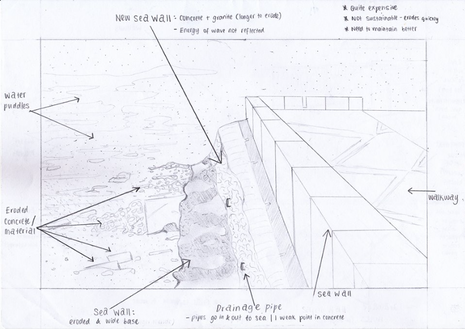
  • As you can see in figure 2, the second defence we observed was a sea wall along the sides of the promenade, which protects the restaurants and recreational facilities behind it. how sustainable?
  • There are 3 parts to this sea defense. The first is a plain, concrete wall at the top. This is the most attractive part of the sea defense as it looks relatively clean and neat compared to the parts bellow it. The wall runs along the top of the sea wall with the main purpose of keeping people safe and not from falling off the sides. It also prevetnts waves from flooding the land use areas. 
  • The second part of the sea defense is the granite and concrete wall. This is the strongest and sturdiest part of the sea defense as it is made out of stronger materials such as granite and concrete, cemented together. Granite is more stable, so the concrete will erode faster leaving an uneven surface in the wall. You can see that there is some rubble that has eroded from the wall, presumably due to the force of the waves. This uneven surface will need to be managed frequently due to fact if some places are weaker, the wall might eventually fall. There is also a curved lip to the wall at the bottom which reflects the force and power of high tide waves. There was previously another sea wall, but it was not strong enough, so they added another, resulting to a 'stair affect.' As we can see from the past, the sea wall is not managed frequently and if not maintained well more money will be need to build a new wall. 
  • Lastly, there is a drain at the bottom of the sea wall. The drain is used to drain water from behind the sea wall. This drain is the weak point in the wall as it is a gap and is relatively vulnerable to erosion. If these weak points get weaker and weaker, the wall might collapse on its self. 
Picture
Figure 2: Sea wall at the promenade.
  • I would rate this wall a 7/10 for efficiency as it is quite secure and a 8/10 for appearance as it is not particularly attractive but is not completely repelling. It looks much more appealing than the first sea defense we saw. 

Mangroves

  • Even though this was not one of the sea defense we were focusing on, mangroves are an excellent natural sea defense. 
  • Mangroves are crossroads where ocean, freshwater, and land realms meet. Mangroves act as a natural sea defence. 
  • They help protect the coast agaisnt natural hazzards such as: storms, tsunamis and coastal erosion. 
  • They reduce: wave impact, storm surges, floods, tsunamis and lessens damage by absorbing wave energy. 
  • The dense roots of manroves help build soils. Above ground roots slow down water flows, encouraging deposition of sediments and reduce erosion. 
  • Build up of soils, increase thickness of soil, which maybe critical as sea level rises. 

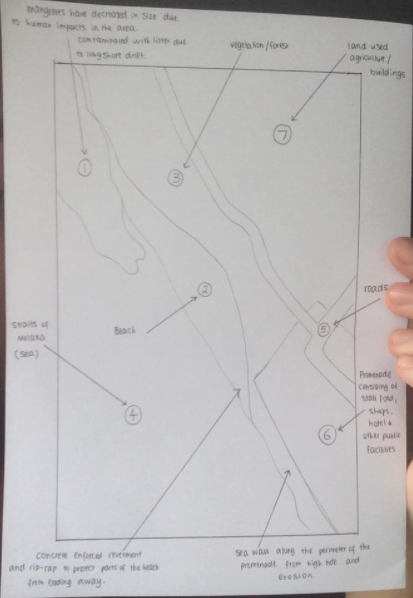
Sketch Map of Pantai Morib (Bird's Eye View)
Picture
Figure 3: Sketch map of Pantai Morib from a bird's eye view. 

Powered by Create your own unique website with customizable templates.